
Why is it So Hard to Stop Biting Your Nails?
If you’ve ever tried to stop biting your nails, you already know it’s not easy.
If stopping was as simple as “just quitting,” you would have done it years ago.
The difficulty lies in your brain’s architecture. Nail biting is a deeply ingrained neural circuit that operates below the level of conscious thought.

It’s not about a lack of discipline. It’s not about being careless. It’s second nature. Before you even realize it, your hands are at your mouth, and the cycle begins again.
- Constant Accessibility: Unlike other habits like smoking or snacking, your “tools” are attached to your hands 24/7. There is no barrier to entry.
- The Autopilot Brain: By the time your conscious mind realizes what’s happening, the damage is already done.
- The Identity Trap: When you’ve bitten for a lifetime, healthy nails feel “foreign.” Your brain clings to the familiarity of the habit.
To understand why quitting is so difficult, you have to look at how habits form and why the brain clings to them.
Why Stopping Feels So Hard to Do
Nail biting isn’t just a surface-level habit. It’s a body-focused repetitive behavior (BFRB), which helps explain why willpower alone often isn’t enough to break free. It’s deeply tied to the way our brains handle stress, focus, and even comfort.
- Constant Accessibility: Unlike other habits like smoking or snacking, your “tools” are attached to your hands 24/7. There is no barrier to entry.
- The Autopilot Brain: By the time your conscious mind realizes what’s happening, the damage is already done.
- The Relief Cycle: In the moment, the short-term comfort of biting outweighs the long-term downsides. That quick hit of relief can override the logical thought of “I should stop.”
- The Identity Trap: When you’ve bitten for a lifetime, healthy nails feel “foreign.” Your brain clings to the familiarity of the habit.
This familiarity and cycle makes it harder to walk away, even when you’re motivated to quit.
Nail Biting as a Habit Loop
Nail biting is a habit. Psychologists describe habits as a loop made up of three parts:
- The Cue: the trigger or reminder that kicks off the habitual behavior.
- The Routine: the habit, or repeated behavior.
- The Reward: what the behavior does for you.
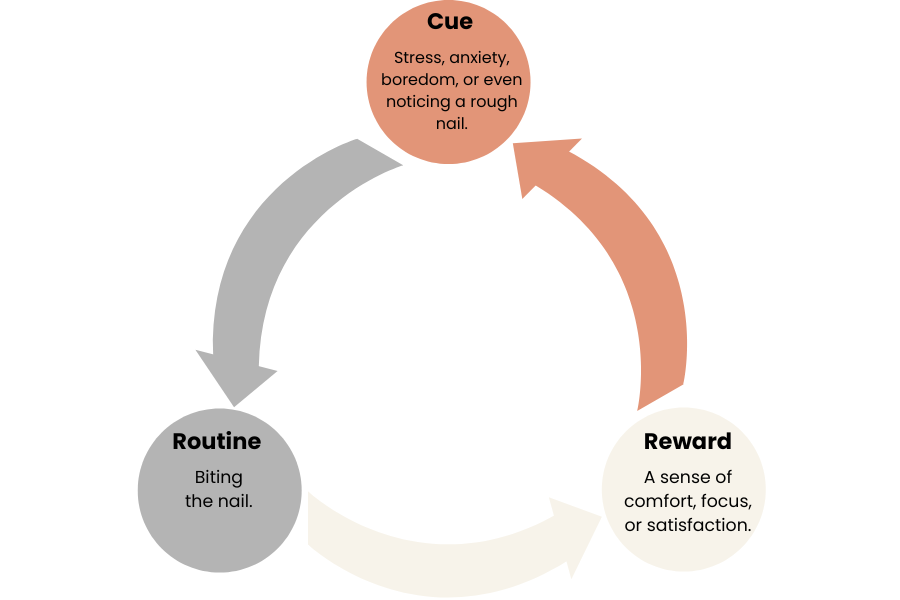
Once the brain learns this loop, it tends to run on autopilot. Even if you want to stop, the loop kicks in when the trigger appears.
And because your nails are almost always in sight, the cue rarely goes away.
Emotional Regulation and Self-Soothing
For many, nail biting works as a coping mechanism to a certain problem or feeling. The act of biting provides a temporary sense of relief.
Psychologists call this “self-soothing,” and it helps explain why the habit can feel so hard to shake.
And every time you bite your nails to get even a tiny sense of relief, your brain reinforces the behavior with a small dopamine release.
This micro-reward makes nail biting become less of a choice and more of an ingrained reflex.
Rewiring the Habit Loop
The good news is that habits, even deeply ingrained ones, can be rewired. Instead of fighting the it, you work with your brain’s natural wiring. It’s replacing it with something healthier that satisfies the same need.
Think of it like this: the loop is still there (trigger, action, reward), but now the “action” becomes a positive choice.
- The Cue: The stress and anxiety of watching my favorite sports team
- The (old) Routine: Biting my nails
- The (new) Routine: Holding a fidget spinner to keep my hands occupied
- The Reward: a sense of relief and satisfaction that my hands are busy.
Other triggers can be addressed in similar ways. If boredom sparks the biting, keep a stress ball in your pocket. If rough nails make you want to chew, have a nail filer on hand. Each of these replacement routines satisfies the brain’s need for comfort while building a new, positive habit.
Over time, these small changes add up. The more you reward yourself for the healthier routine, the stronger it becomes. Your brain starts to associate the trigger with a positive, non-damaging action, gradually weakening the old nail-biting pathway.
It isn’t willpower, but rather training your brain to respond differently.
Eventually, the urge to bite can fade because your brain learns there’s a better way to get the relief it wants.
It’s Hard, But it’s Possible to Bite the Habit
Quitting any habit takes more than just willpower.
Understanding the psychology behind it helps you see nail biting not as a weakness, but as a habit that can be unlearned with the right tools and patience.
And one last thing, there is no shame in seeking professional help or therapy. Bettering yourself should not be judged. Just know there are millions of people trying to quite every single day. And there are thousands of people that want